 Pin it
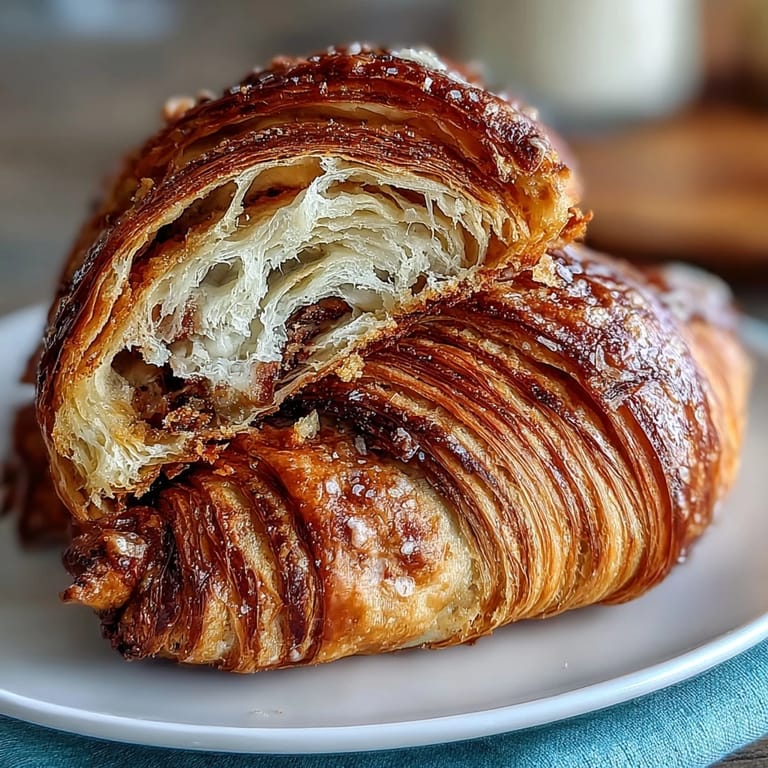
 My apartment smelled like a Parisian bakery for the first time when I stopped being afraid of laminated dough. It wasn't some romantic moment—I'd burned my fingers twice, forgotten the butter block in the fridge, and had to restart my folds halfway through. But when those sourdough croissants emerged golden and impossibly flaky, my roommate practically inhaled three in a row. That's when I realized this recipe wasn't just about technique; it was about trusting the overnight rest and letting time do what rushing never could.
I made these for a Sunday morning when my sister was visiting, and I'll never forget her taking that first bite in complete silence. The look on her face—eyes closed, small smile—made me feel like I'd accomplished something real, even though I'd mostly just waited and folded butter. She asked if I'd learned this from a professional baker, and I had to laugh and show her my flour-dusted phone with these exact instructions pulled up.
Ingredients
- Bread flour (500 g): Choose a good quality bread flour with decent protein content; all-purpose won't give you the same structure and chew that makes croissants feel substantial rather than wimpy.
- Granulated sugar (60 g): This feeds the sourdough starter and balances the tanginess, so don't skip it or reduce it trying to make these savory.
- Fine sea salt (10 g): Use fine salt because coarse crystals won't distribute evenly and you'll get weird salty pockets in your dough.
- Cold whole milk (240 ml): Temperature matters here—cold milk keeps the dough manageable and prevents the butter from melting into the dough before you're ready for it.
- Active sourdough starter at 100% hydration (100 g): If your starter is thinner or thicker, you might need to adjust the milk slightly, but the tartness will be worth whatever small tweaks you make.
- Unsalted butter, softened (30 g): This small amount in the dough itself helps with texture; save your lamination butter for the butter block where it actually matters.
- Cold unsalted butter block (250 g): This is the star ingredient and must be cold but not rock-hard when you pound it—it should be pliable enough to fold without cracking.
- Egg wash (1 large egg plus 1 tbsp milk): The milk in the egg wash dilutes it so the egg doesn't cook too fast and burn before the inside of the croissant is done.
Tired of Takeout? 🥡
Get 10 meals you can make faster than delivery arrives. Seriously.
One email. No spam. Unsubscribe anytime.
Instructions
- Mix the dough base:
- Combine flour, sugar, and salt in a large bowl, then add the cold milk, sourdough starter, and softened butter. Mix until everything comes together, then knead for about 8 minutes until the dough is smooth and elastic—you'll feel the transformation from shaggy to silky in your hands.
- First chill:
- Shape the dough into a rough rectangle, wrap it tightly in plastic wrap, and refrigerate for at least 2 hours. This resting period relaxes the gluten and makes the dough easier to roll out without shrinking back at you.
- Prepare the butter block:
- Place the cold butter between two sheets of parchment paper and pound it with a rolling pin until it's a flexible rectangle about 20 x 15 cm. The goal is butter that bends without cracking—if it shatters, it's too cold and needs a few minutes at room temperature.
- First fold (envelope method):
- Roll your chilled dough to about 40 x 20 cm on a lightly floured surface, place the butter block on one half, fold the dough over it, and seal the edges with the rolling pin. This is your first lamination, and you should feel slightly nervous but also oddly calm because the dough is cooperating.
- First turn:
- Turn the dough 90 degrees so the fold line is perpendicular to you, then roll it into a 60 x 20 cm rectangle. Fold it into thirds like a letter (top third down, bottom third up), wrap it, and chill for 1 hour.
- Repeat the turns:
- Complete this process two more times—each roll, fold, wrap, and chill cycle creates more layers of butter and dough that will become those crispy, flaky leaves in the final croissant. The rhythm becomes almost meditative by the third turn.
- Overnight rest:
- After your final fold, wrap the dough and refrigerate it for 8 to 12 hours. This long chill does two things: it gives the dough time to relax and prevents the butter from separating, and it also lets the sourdough flavor deepen into something more complex.
- Cut and shape:
- Roll the chilled dough into a large rectangle about 60 x 30 cm and 5 mm thick, then cut it into 12 long triangles using a sharp knife. Starting from the wide end of each triangle, roll it tightly toward the point, then tuck the tip underneath to create that classic croissant crescent shape.
- Proof the croissants:
- Place shaped croissants on parchment-lined baking sheets, cover them loosely with a damp towel or plastic wrap, and let them proof at room temperature for 2 to 3 hours until they've roughly doubled in size. You'll know they're ready when they feel pillowy but still hold their shape when you gently poke them.
- Apply egg wash and bake:
- Preheat your oven to 200°C (400°F), whisk together the egg and milk for the egg wash, and brush it lightly over each croissant. Bake for 18 to 22 minutes until the croissants are deep golden brown and you can hear them crackle when you tap the pan.
- Cool and serve:
- Let the croissants cool for a few minutes on the pan before transferring them to a wire rack—eating them while still warm is non-negotiable, though they're still pretty good at room temperature if you can somehow wait.
 Pin it
 There's a moment, usually around 2:30 p.m. on baking day, when your kitchen fills with that buttery, yeasty smell and you suddenly understand why people wake up early for croissants. Mine weren't perfect—one came out slightly lopsided, another was a little too dark—but they tasted like I'd been practicing this for years instead of just following instructions and getting lucky.
The Sourdough Difference
Using sourdough starter instead of commercial yeast changes everything about how these croissants taste and how they develop. The natural fermentation adds a subtle tang that balances the richness of all that butter, and it gives the crumb a more complex flavor that unfolds as you eat rather than just tasting like butter and flour. I've made these with instant yeast out of desperation, and they're fine, but they're missing that depth that makes someone close their eyes mid-bite.
Lamination Anxiety and How to Beat It
The lamination process feels intimidating until you realize it's just repeated folds and chills—there's nothing that can go catastrophically wrong that you can't fix with a longer rest in the fridge. I stressed about getting the folds perfectly even the first time, but slight imperfections actually create more interesting texture because the layers aren't uniform. The most important thing is maintaining cold temperatures and not rushing between folds, which is why I always do my lamination on a cool day or in a cool corner of my kitchen.
- If your dough starts feeling warm and sticky during rolling, just cover it and stick it in the fridge for 15 minutes—patience here prevents the entire project from falling apart.
- Flour your surface generously when rolling to prevent sticking, but brush off excess flour before folding so you don't incorporate dry flour into your layers.
- The dough should feel slightly cool and firm when you're working with it, never warm and soft—if it is warm, you've waited too long between steps.
 Pin it
 These croissants taught me that sometimes the best results come not from stress and precision, but from respecting time and temperature and trusting that the process works. Make a batch, fill your home with that bakery smell, and enjoy something that tastes fancy but required nothing more than patience and a little butter.
Recipe FAQs
- → How does sourdough affect the croissant flavor?
Sourdough adds a subtle tang that enhances the buttery richness and gives a more complex, slightly tangy taste compared to traditional yeasted croissants.
- → What is the purpose of chilling dough between folds?
Chilling solidifies the butter and relaxes the gluten, which helps create the distinct flaky layers when baked.
- → Can I prepare the dough in advance?
Yes, an overnight rest in the refrigerator allows fermentation to develop flavor and improves texture.
- → What is the ideal baking temperature and time?
Bake at 200°C (400°F) for 18-22 minutes until golden and crisp for optimal results.
- → Are there variations to the filling or toppings?
Yes, fillings like cheese, ham, or sweet jams add delightful twists before rolling and baking.